ISO 9001 for Construction Companies: 7 Powerful Quality Benefits
ISO 9001 for Construction Companies: 7 Powerful Quality Benefits
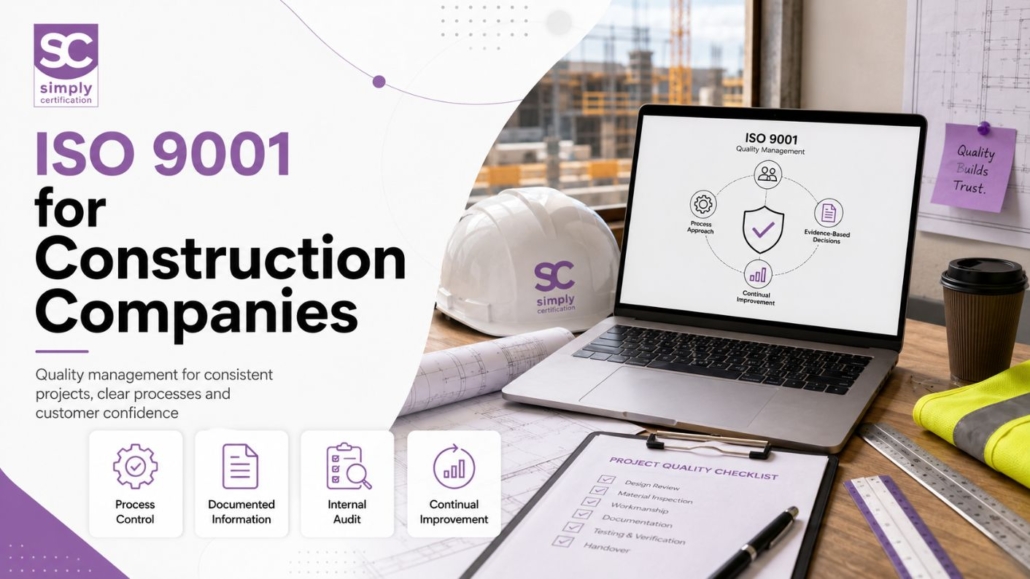
ISO 9001 for construction companies provides a recognised framework for managing quality, improving process control and demonstrating that key activities are being reviewed and evidenced.
In construction, quality is not only about the finished project. It is also about planning, communication, documentation, supplier management, site checks, handover records, customer feedback and continual improvement.
Many construction businesses already have parts of a quality management system in place. You may already use project files, site checklists, supplier records, inspection forms, handover documents and customer feedback. ISO 9001 brings these activities together into a structured quality management system, often called a QMS.
This guide explains what ISO 9001 means for construction companies, why it matters, what it commonly includes and what organisations may want to consider before applying for certification.
Simply Certification is a UKAS-accredited certification body providing independent and impartial certification assessment services.
If you would like to better understand your current position before applying for certification, complete our ISO 9001 readiness questionnaire here: ISO 9001 – Self Assessment
Please note: the questionnaire is a general readiness self-check only. It does not replace a formal certification assessment, does not provide consultancy and does not confirm whether certification will be awarded.
What is ISO 9001 for construction companies?
ISO 9001 for construction companies is the application of the ISO 9001 quality management standard within a construction business.
It helps organisations demonstrate how quality is managed across their activities. This may include enquiry handling, quoting, contract review, project planning, procurement, site delivery, inspection, customer handover and corrective action.
A quality management system should reflect the way the company actually works. It should not be paperwork created only for an audit. The system should be understandable, usable and supported by evidence.
For a construction company, this evidence may include:
- Project quality plans
- Site inspection records
- Approved supplier records
- Staff competence records
- Customer requirements
- Design or specification records
- Risk and opportunity information
- Non-conformance records
- Corrective action records
- Handover documents
- Internal audit reports
- Management review records
The exact records needed will depend on the company’s size, scope, services and project activities.
Why ISO 9001 matters in construction
Construction projects often involve multiple people, suppliers, contractors, locations, documents and deadlines. This can make quality management more complex.
A clear quality management system helps construction companies control how work is planned, delivered, checked and reviewed.
Without a structured system, important information can be missed or handled inconsistently. Different teams may use different templates. Supplier records may not be reviewed. Site issues may be corrected but not properly recorded. Customer feedback may not be used to improve future work.
ISO 9001 provides a framework for managing these areas in a consistent and evidence-based way.
For construction companies, this can support:
- Clearer project processes
- Better document control
- More consistent site records
- Improved supplier monitoring
- Stronger customer confidence
- Better internal communication
- More structured continual improvement
It can also be useful when customers, contractors, local authorities, housing providers or procurement teams ask for evidence of a recognised quality management system.
7 quality benefits of ISO 9001 for construction companies
1. Clearer construction processes
Construction work often involves many stages, from initial enquiry through to completion and handover.
A quality management system helps define how these stages are controlled. This may include how enquiries are reviewed, how quotes are approved, how project information is communicated and how completion records are checked.
Clearer processes can reduce confusion and help teams understand what needs to happen at each stage.
For example, a contractor may have defined processes for:
- Tender review
- Contract acceptance
- Project planning
- Procurement
- Site inspections
- Subcontractor control
- Client communication
- Handover
- Defect management
When processes are clearly mapped, it becomes easier to identify where evidence is created and where controls are needed.
2. Better document and record control
Construction companies often manage large amounts of information.
This may include drawings, specifications, method statements, inspection records, site photographs, supplier documents, customer approvals, certificates, training records and handover packs.
Document control helps ensure people are using the correct information at the right time.
A quality management system should help answer questions such as:
- Which version of a document is current?
- Where are project records stored?
- Who can approve changes?
- What evidence needs to be retained?
- How are completed records reviewed?
- How long should records be kept?
Good document control can reduce the risk of outdated information being used and make it easier to provide evidence during an assessment.
3. Stronger supplier and subcontractor control
Many construction companies rely on suppliers and subcontractors.
ISO 9001 for construction companies includes consideration of externally provided processes, products and services. In practical terms, this means the organisation should understand how suppliers and subcontractors are selected, approved, monitored and reviewed.
Supplier controls may include:
- Approved supplier lists
- Subcontractor competence checks
- Insurance or certification records
- Performance reviews
- Delivery records
- Non-conformance records
- Feedback from project teams
The level of control should be proportionate to the risk and importance of the supplier or subcontractor activity.
For example, a subcontractor carrying out critical site work may need a different level of review compared with a low-risk general supplier.
4. More consistent quality checks
Site inspections and quality checks are an important part of construction quality management.
A quality management system can help make these checks more consistent by setting out what should be checked, when checks should happen, who is responsible and what records should be kept.
Examples may include:
- Pre-start checks
- Material checks
- Workmanship inspections
- Stage inspections
- Snagging records
- Testing and verification
- Handover checks
- Defect records
The purpose is not simply to create forms. The purpose is to provide evidence that the company has a controlled approach to checking work and managing quality issues.
5. Improved customer confidence
Customers want confidence that a construction company can deliver work in a controlled and consistent way.
ISO 9001 certification can help provide that confidence because it shows the organisation’s quality management system has been independently assessed against a recognised standard.
For construction companies, this can be relevant when working with:
- Main contractors
- Developers
- Housing associations
- Local authorities
- Commercial clients
- Framework providers
- Public sector procurement teams
Certification does not guarantee future performance, but it can demonstrate that the company has a structured system for managing quality.
6. Better handling of issues and corrective actions
In construction, issues can happen. Materials may be delayed, specifications may change, work may need correction or records may be incomplete.
A quality management system helps organisations manage these issues in a structured way.
This may include recording:
- What happened
- Where it happened
- Who was involved
- What immediate action was taken
- What caused the issue
- What corrective action was agreed
- Whether the action was effective
The aim is to reduce repeat issues and support continual improvement.
A useful corrective action process should focus on understanding causes and improving the system, rather than simply assigning blame.
7. Continual improvement across projects
Continual improvement is an important part of ISO 9001.
For construction companies, this means using evidence from projects to improve future performance.
Improvement opportunities may come from:
- Customer feedback
- Project reviews
- Internal audits
- Site inspection results
- Supplier performance
- Complaints
- Non-conformities
- Management review
- Lessons learned meetings
Small improvements can have a significant effect over time. This could include updating a checklist, improving handover records, changing a supplier review process or making project responsibilities clearer.
The key is that improvement actions should be reviewed and evidenced.
What should a construction quality management system include?
The structure of a construction quality management system will depend on the organisation’s activities, size and scope.
However, many systems include:
- Quality policy
- Quality objectives
- QMS scope
- Process map
- Roles and responsibilities
- Document control process
- Project control process
- Supplier and subcontractor controls
- Competence and training records
- Risk and opportunity information
- Site inspection records
- Customer feedback process
- Complaint handling process
- Non-conformance records
- Corrective action records
- Internal audit programme
- Management review records
The system should be proportionate. A small contractor does not need the same level of complexity as a large construction group with multiple sites and departments.
The most important point is that the system must be relevant, controlled and supported by evidence.
ISO 9001 for construction companies and tenders
ISO 9001 for construction companies is often relevant in tendering and procurement.
Some clients and frameworks ask suppliers to show evidence of quality management. This may include certification to ISO 9001 or evidence of an equivalent quality management system.
For construction companies, certification can support tender submissions by showing that the organisation’s quality management system has been independently assessed.
However, certification should not be viewed only as a tender requirement. A well-managed system should also support day-to-day operations, project consistency and continual improvement.
If a tender specifically asks for UKAS-accredited certification, it is important to check that the certification body is accredited for the relevant management system certification activity.
What happens during ISO 9001 assessment?
Certification to ISO 9001 involves an independent assessment of the organisation’s quality management system.
The assessment considers whether the system meets the requirements of the standard and whether it is being applied in practice.
For a construction company, an assessment may include reviewing evidence such as:
- Quality policy and objectives
- Project files
- Process records
- Site inspection records
- Supplier reviews
- Training and competence records
- Customer feedback
- Complaint records
- Non-conformance records
- Corrective actions
- Internal audits
- Management review
The auditor may sample records from different activities or projects to understand how the system works in practice.
Certification is only awarded following a successful assessment against the relevant requirements.
What is UKAS-accredited ISO 9001 certification?
UKAS is the UK’s National Accreditation Body.
A UKAS-accredited certification body has been assessed by UKAS for competence to provide certification services within its accredited scope.
It is important to use the wording correctly:
- A construction company is certified to ISO 9001.
- A certification body is accredited by UKAS.
Simply Certification is a UKAS-accredited certification body providing independent and impartial certification assessment services.
UKAS-accredited management system certificates can be checked through UKAS CertCheck.
Does ISO 9001 replace construction compliance requirements?
No. ISO 9001 does not replace legal, regulatory, contractual or sector-specific requirements.
Construction companies still need to understand and meet applicable obligations relevant to their work. These may relate to areas such as health and safety, building regulations, contractual requirements, competence, environmental controls or scheme-specific requirements.
ISO 9001 supports quality management. It provides a framework for managing processes and evidence, but it does not remove the need to comply with other applicable requirements.
This distinction is important because certification to ISO 9001 should not be presented as proof of compliance with every construction requirement.
Readiness questions for construction companies
Before applying for certification, a construction company may want to reflect on its current position.
Useful questions include:
- Is the scope of the quality management system clearly defined?
- Are project processes mapped or described?
- Are responsibilities clear across office and site teams?
- Are customer and contract requirements reviewed?
- Are documents and records controlled?
- Are supplier and subcontractor controls in place?
- Are site checks recorded consistently?
- Are training and competence records maintained?
- Are complaints and non-conformities recorded?
- Are corrective actions followed up?
- Are internal audits completed?
- Has management review taken place?
- Is there evidence of continual improvement?
These questions are not a substitute for formal assessment. They can help organisations understand whether key information may need to be reviewed before applying.
ISO 9001 for construction companies checklist
Use this simple self-check to consider your current position.
Your organisation may want to review whether it has:
- A defined QMS scope
- A quality policy
- Measurable quality objectives
- A process map
- Project control procedures
- Clear role responsibilities
- Document control arrangements
- Controlled project records
- Supplier and subcontractor records
- Training and competence records
- Risk and opportunity information
- Site inspection evidence
- Customer feedback records
- Complaint records
- Non-conformance records
- Corrective action records
- Internal audit reports
- Management review records
- Improvement actions
If several areas are unclear, the organisation may need to review its current system before applying for certification.
Frequently asked questions
What is ISO 9001 for construction companies?
ISO 9001 for construction companies means applying the ISO 9001 quality management standard to construction activities. It helps organisations demonstrate how quality is managed through processes, records, responsibilities and continual improvement.
Is ISO 9001 mandatory for construction companies?
ISO 9001 is not automatically mandatory for every construction company. However, some customers, tenders, frameworks or supply chains may request certification or evidence of a quality management system.
What does a construction QMS include?
A construction QMS may include quality policy, objectives, project control processes, supplier records, site inspection records, training records, customer feedback, internal audits, corrective actions and management review.
Can small construction companies apply for ISO 9001 certification?
Yes. ISO 9001 can apply to organisations of different sizes. The quality management system should be proportionate to the size, activities and complexity of the company.
Does ISO 9001 cover health and safety?
ISO 9001 focuses on quality management. It does not replace health and safety legal duties or other construction compliance requirements.
What is the first step before applying for certification?
A useful first step is to review the current quality management system and consider whether key processes, responsibilities, records, internal audits and management review evidence are in place.
Does completing a readiness questionnaire guarantee certification?
No. A readiness questionnaire is a general self-check only. It does not replace formal assessment, does not provide consultancy and does not guarantee certification.
Understand your current readiness position
ISO 9001 for construction companies can help organisations demonstrate a structured approach to quality management, process control and continual improvement.
Before applying for certification, it may be helpful to understand your current position.
Complete our ISO 9001 readiness questionnaire here: ISO 9001 – Self Assessment