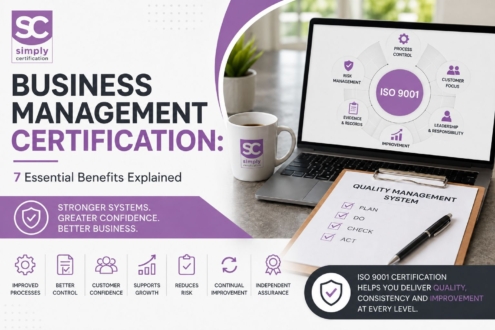
Business Management Certification: 7 Essential Benefits Explained
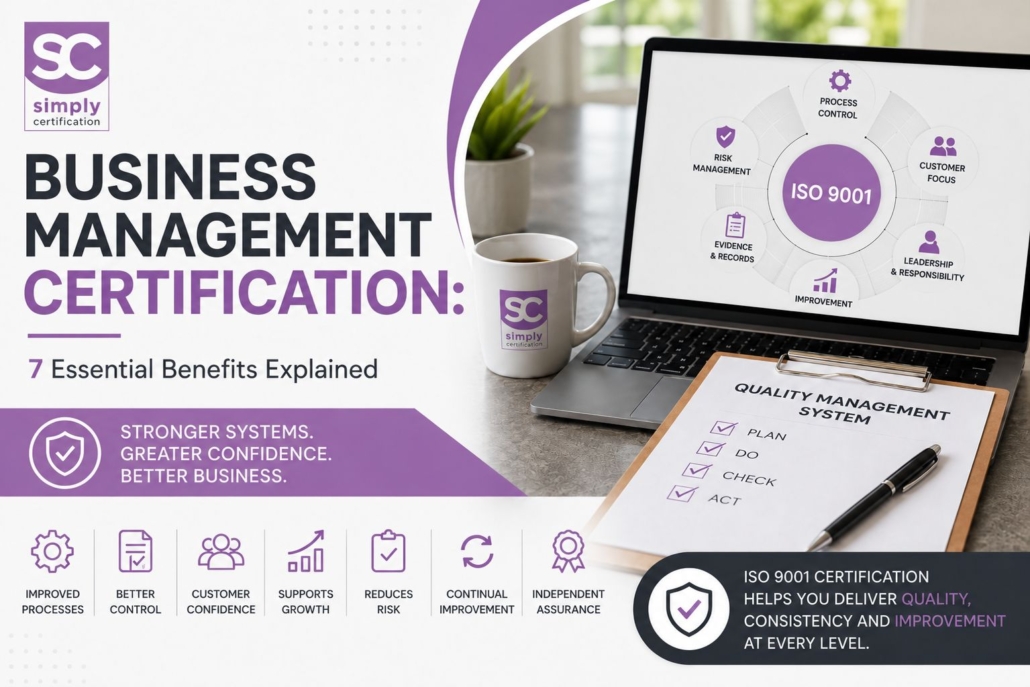
Business management certification can help an organisation demonstrate that it has a structured approach to quality, consistency, process control and continual improvement.
For many businesses, this is closely linked to ISO 9001, the internationally recognised standard for quality management systems. ISO 9001 focuses on how an organisation manages its processes, responsibilities, customer requirements, records, internal audits, management review and improvement activity.
In simple terms, business management certification gives customers, contractors and procurement teams confidence that an organisation’s management system has been independently assessed against recognised requirements.
Business management certification is often used by organisations that want to evidence a structured approach to quality management. When linked to ISO 9001, it focuses on how the organisation controls processes, manages responsibilities, reviews records, handles customer requirements and supports continual improvement.
This makes ISO 9001 a relevant route for businesses that want their management system independently assessed against recognised quality management requirements.
This guide explains what business management certification means, how it links to ISO 9001, the benefits it can provide and what organisations may want to consider before applying for certification.
Simply Certification is a UKAS-accredited certification body providing independent and impartial certification assessment services.
If you would like to better understand your current position before applying for ISO 9001 certification, complete our readiness questionnaire here: ISO 9001 – Self Assessment
What is business management certification?
Business management certification is the independent assessment of an organisation’s management system against a recognised standard or defined set of requirements.
A management system is the way an organisation controls and reviews important parts of how it works. This may include processes, responsibilities, documents, records, customer feedback, internal checks and improvement actions.
When linked to ISO 9001, business management certification focuses on quality management. This means looking at how the organisation manages quality across its activities and whether the system is being applied in practice.
Business management certification is not the same as an individual training certificate. It usually relates to an organisation’s management system, rather than one person’s qualification.
For ISO 9001, the assessment considers whether the organisation has a suitable quality management system in place and whether there is evidence that it is being followed.
How business management certification links to ISO 9001
For many organisations, ISO 9001 is the most relevant route when looking at business management certification.
ISO 9001 is focused on quality management. It provides a framework for organisations that want to demonstrate how they manage customer requirements, process control, responsibilities, documented information and continual improvement.
This makes ISO 9001 relevant for businesses that want to evidence a structured approach to the way they operate.
An ISO 9001 quality management system may include:
- A defined scope
- A quality policy
- Quality objectives
- A process map
- Clear roles and responsibilities
- Controlled documents and records
- Risk and opportunity considerations
- Supplier controls
- Customer feedback records
- Complaint records
- Non-conformance records
- Corrective actions
- Internal audits
- Management review
- Continual improvement actions
You can learn more about ISO 9001 here: ISO 9001 Certification | Demonstrate a commitment to quality
Why business management certification matters
Business management certification matters because many organisations are expected to provide evidence of how they manage quality.
Customers, contractors, framework providers and procurement teams may want to see that a business has clear processes, controlled records and a structured approach to improvement.
Without a recognised management system, this can be harder to demonstrate.
A quality management system linked to ISO 9001 can help an organisation evidence how it:
- Understands customer requirements
- Controls key processes
- Manages documents and records
- Reviews supplier performance
- Handles complaints and issues
- Records corrective actions
- Completes internal audits
- Reviews management system performance
- Identifies improvement opportunities
Certification provides independent assessment of whether the system meets the relevant requirements and is being applied in practice.
7 essential benefits of business management certification
1. Clearer business processes
One of the main benefits of business management certification is clearer process control.
A business may already have processes in place, but they may not always be written down, reviewed or followed consistently. ISO 9001 encourages organisations to identify key processes and understand how they connect.
This may include processes for:
- Enquiry handling
- Quoting
- Contract review
- Planning work
- Purchasing
- Service delivery
- Customer communication
- Complaint handling
- Internal audits
- Corrective actions
- Management review
Clearer processes help teams understand what needs to happen, who is responsible and what evidence should be retained.
For growing businesses, this can be especially useful. As more people become involved, relying on informal knowledge can create gaps. A structured quality management system helps reduce that risk.
2. Better control of documents and records
Business management certification is evidence-based.
This means an organisation should be able to show that its system is documented where required and that records are being kept.
Documents explain what should happen.
Records show what has happened.
For example, a process may explain how customer complaints are handled. A completed complaint record and corrective action record can show how the process was followed.
Good document and record control helps an organisation understand:
- Which documents are current
- Where information is stored
- Who can approve changes
- What records need to be kept
- How records are protected
- How long records should be retained
This is important for ISO 9001 because the assessment does not only look at whether documents exist. It also considers whether the system is being used in practice.
3. Stronger customer confidence
Customers often want reassurance that a business can deliver consistently.
Business management certification can support this by showing that the organisation’s management system has been independently assessed.
For organisations seeking ISO 9001 certification, this can help demonstrate that quality is being managed through a structured system.
This may be relevant when working with:
- Main contractors
- Housing providers
- Local authorities
- Public sector organisations
- Framework providers
- Commercial clients
- Larger supply chains
Certification does not guarantee future performance. However, it can show that the organisation has a quality management system in place and that it has been assessed against recognised requirements.
4. Improved tender and framework readiness
Some tenders and frameworks ask organisations to provide evidence of quality management.
Business management certification linked to ISO 9001 can support this where the tender asks for certification or evidence of a recognised quality management system.
This can be particularly relevant for businesses working in sectors such as:
- Construction
- Retrofit
- Renewables
- Facilities management
- Engineering
- Manufacturing
- Public sector supply chains
- Professional services
It is important to check the exact wording of any tender requirement. Some may ask for ISO 9001 certification specifically. Others may ask for evidence of an equivalent quality management system.
If UKAS-accredited certification is requested, the organisation should check that the certification body is accredited for the relevant certification activity.
5. Clearer roles and responsibilities
A management system should make responsibilities clear.
People involved in key activities should understand what they are responsible for, what records they need to complete and when issues need to be escalated.
This can help reduce confusion, duplicated work and missed tasks.
Responsibilities may include:
- Reviewing customer requirements
- Approving documents
- Monitoring quality objectives
- Managing supplier records
- Recording complaints
- Reviewing non-conformities
- Completing internal audits
- Managing corrective actions
- Reviewing system performance
Clear responsibilities are important because quality management should not sit with one person alone. It should be understood across the relevant parts of the organisation.
For ISO 9001, leadership involvement and clear accountability are important parts of a working quality management system.
6. More structured improvement
Business management certification supports a more structured approach to improvement.
A quality management system should not remain static. It should be reviewed, monitored and improved where needed.
Improvement may come from:
- Customer feedback
- Complaints
- Non-conformities
- Internal audit findings
- Supplier performance
- Process performance
- Management review
- Corrective actions
- Lessons learned
Improvement does not always mean major change. It may involve updating a form, improving a handover process, clarifying a responsibility, reviewing supplier controls or improving how records are stored.
The key point is that improvement actions should be considered, recorded and reviewed where relevant.
This is one of the reasons ISO 9001 is often linked to business management certification. It encourages organisations to look at how their system is performing and where improvements may be needed.
7. Independent evidence of a managed system
One of the main reasons organisations seek business management certification is to provide independent evidence.
A customer or procurement team may want to know that a business has a structured system in place. Certification can help evidence that the system has been assessed.
For ISO 9001, this assessment focuses on the organisation’s quality management system.
It is important to use the correct wording:
- An organisation is certified to ISO 9001.
- A certification body is accredited by UKAS.
Simply Certification is a UKAS-accredited certification body providing independent and impartial certification assessment services.
Certification is only awarded following a successful assessment against the relevant requirements.
What should be included in a quality management system?
A quality management system should be proportionate to the organisation.
A small business does not need the same level of complexity as a large organisation with multiple departments, sites or activities. However, the system should still be clear, controlled and supported by evidence.
For ISO 9001, a quality management system may include:
- Scope of the quality management system
- Quality policy
- Quality objectives
- Process map
- Roles and responsibilities
- Document control
- Record control
- Risk and opportunity information
- Supplier controls
- Training and competence records
- Customer feedback records
- Complaint handling
- Non-conformance records
- Corrective actions
- Internal audits
- Management review
- Continual improvement actions
The system should reflect how the organisation actually works. It should not be paperwork created only for an audit.
What happens during certification assessment?
Certification assessment involves an independent review of the organisation’s management system.
For ISO 9001, the assessment considers whether the quality management system meets the requirements of the standard and whether it is being applied in practice.
This may involve reviewing documented information, sampling records, speaking with relevant personnel and checking how processes are controlled.
Evidence may include:
- Quality policy
- Quality objectives
- Process records
- Training records
- Supplier records
- Customer feedback
- Complaint records
- Non-conformance records
- Corrective actions
- Internal audit records
- Management review records
- Improvement actions
Certification is not automatic. It can only be awarded following a successful assessment.
A readiness questionnaire can help an organisation reflect on its current position, but it does not replace formal certification assessment.
Business management certification and UKAS accreditation
UKAS is the UK’s National Accreditation Body.
A UKAS-accredited certification body has been assessed by UKAS to provide certification services within its accredited scope.
For organisations applying for certification, this can provide confidence that the certification body has been independently assessed for competence and impartiality.
When discussing certification, it is important to be clear and accurate.
The organisation is certified to ISO 9001.
The certification body is accredited by UKAS.
UKAS-accredited management system certificates can be checked through UKAS CertCheck.
Readiness questions before applying for ISO 9001 certification
Before applying for ISO 9001 certification, organisations may want to reflect on whether key parts of their quality management system are in place.
Useful questions include:
- Is the scope of the quality management system clear?
- Is there a relevant quality policy?
- Are quality objectives in place?
- Are key processes mapped or described?
- Are roles and responsibilities understood?
- Are documents and records controlled?
- Are customer requirements reviewed?
- Are supplier controls in place where relevant?
- Are training and competence records available?
- Are complaints and non-conformities recorded?
- Are corrective actions reviewed?
- Have internal audits been completed?
- Has management review taken place?
- Is there evidence of continual improvement?
These questions are not a substitute for formal assessment. They can help organisations understand whether their current system is ready to be reviewed.
Business management certification checklist
Use this checklist as a general self-check before applying for ISO 9001 certification.
Your organisation may want to review whether it has:
- A defined quality management system scope
- A quality policy
- Quality objectives
- A process map
- Clear responsibilities
- Controlled documents
- Organised records
- Risk and opportunity information
- Supplier monitoring where relevant
- Training and competence records
- Customer feedback records
- Complaint records
- Non-conformance records
- Corrective action records
- Internal audit evidence
- Management review records
- Improvement actions
If several areas are unclear, the organisation may need to review its current system before applying for certification.
Frequently asked questions
What is business management certification?
Business management certification is the independent assessment of an organisation’s management system against a recognised standard or defined set of requirements.
How does business management certification link to ISO 9001?
Business management certification can link to ISO 9001 when the organisation wants to demonstrate a structured approach to quality management. ISO 9001 focuses on processes, customer requirements, records, internal audits, management review and continual improvement.
Is ISO 9001 a business management certification?
Yes. ISO 9001 is a recognised quality management system standard and is commonly used by organisations seeking certification for quality management.
Is business management certification for individuals or organisations?
In this context, it refers to organisational certification. It is different from an individual training certificate or personal qualification.
Does certification guarantee tender success?
No. Certification may support tender submissions where it is requested, but it does not guarantee tender success. Tender outcomes depend on the full requirements of the procurement process.
What does UKAS-accredited certification mean?
UKAS-accredited certification means the certification body has been assessed by UKAS for competence within its accredited scope. The organisation is certified to ISO 9001, while the certification body is accredited by UKAS.
What is the first step before applying?
A useful first step is to review the current quality management system and consider whether key processes, records, internal audits and management review evidence are in place.
Understand your current readiness position
Business management certification can help organisations demonstrate a structured approach to quality management through ISO 9001.
Before applying for certification, it may be useful to understand your current position.
Complete our ISO 9001 readiness questionnaire here: ISO 9001 – Self Assessment.
This questionnaire is intended as a general self-check only. It does not provide consultancy, does not replace formal certification assessment and does not guarantee any certification outcome.
Simply Certification is a UKAS-accredited certification body providing independent and impartial certification assessment services.
You can also learn more about ISO 9001 here: ISO 9001 Certification | Demonstrate a commitment to quality