
What are the 10 important steps to certification? If you’re a contractor or business that installs renewable energy technology and is looking to work on government-backed energy efficiency schemes in the UK, obtaining MCS certification is essential! MCS certification sets the standard for installing renewable energy technologies, ensuring quality, compliance, and customer confidence. However, the process can seem tricky without the right guidance.
In this blog, we’ll explain the 10 important steps to certification for MCS, from understanding the requirements to passing assessments and maintaining compliance. Whether you’re new to the process or seeking to refine your approach, this guide will help you navigate the certification journey with confidence.
First Things First…What is MCS Certification?
The Microgeneration Certification Scheme (MCS) is the UK’s nationally recognised quality standard for small-scale, renewable energy technologies. It ensures that both the products used and the installers who fit them meet rigorous performance, safety, and quality standards.
MCS certification applies to renewable technologies such as:
-
Solar Photovoltaics (PV)
-
Air and Ground Source Heat Pumps
-
Solar Thermal
-
Battery Storage
For installers, MCS certification isn’t just about credibility – it’s financial gateway. Homeowners and businesses can only access government-backed incentives (like the Smart Export Guarantee) if their system is installed by an MCS-certified installer using MCS-certified products.
Who provides MCS certification?
MCS certification is provided by UKAS-accredited certification bodies that assess businesses for compliance with the MCS standard. These organisations audit installers, ensuring they meet the required standards for quality, competence, and compliance. An example of a UKAS-accredited certification body is us – Simply Certification!
One difficult thing to decide is which certification body you should choose. Many different factors can influence your decision including:
- Assessor availability
- Customer service
- The costs and fees involved
- Reputation and track record
- Expertise and experience
Choosing Simply Certification as your certification body for MCS has a whole host of benefits. Our team is made up of leading experts in MCS and we can answer your questions quickly. The service we provide is supportive and responsive – gaining certification can be a little daunting and we remove the fear factor. Take a look to see what one of our customers had to say:
“A very comprehensive and diligent process from start to finish. I would highly recommend Simply Certification and will feel assured when working with any companies who carry accreditation provided by them”.
Nebula Renewables Ltd
If you still cannot decide, don’t worry, we’ve got you covered! Just check out one of our previous blogs, 8 Things to look for when choosing a certification body.
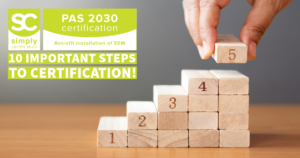
What are the 10 Important Steps to Certification?
To achieve MCS certification, businesses must follow a structured process to ensure compliance with the standard. Below are our 10 important steps to certification:
#1 – Access Simply Hub
We have a self service onboarding system, called Simply Hub. To start the process of certification with us, you will need access to this as the first step.
To access you need to register your interest and a link to access Simply Hub will be sent to you to start the application process.
#2 – A quotation will be issued within Simply Hub
Almost like a shopping basket, a quote in Simply Hub will be presented to you. You can amend the measures you wish to go for as many times as you wish. Once you are happy to proceed, just accept the quotation.
#3 – Pay the invoice and complete the contract documentation from PandaDocs
An invoice will be sent to you once your quotation has been accepted. Once you have paid the invoice you will be emailed the contract documentation via PandaDocs. Once this is completed you will receive an assessment Checklist.
#4 – Assessment Preparation and Checklist Update
You must prepare for your assessments, ensuring you have the required evidence available to present to us, showing compliance to the standards you have applied for. As we are a certification body, we are not allowed to support you in the preparation or advise you. To protect you from a high number of non conformances we ask that you complete the online checklist so you can be confident you are ready.
#5 – Assessment Plan and Bookings
Once we have received your completed checklist – our bookings team will be in touch with you we will then schedule your assessment with our assessors.
#6 – Head Office Assessment
This is currently conducted onsite, our assessor will spend a day with you to run through your documentation, processes and procedures to ensure they are all in line with the standard.
#7 – Technical Inspections
Our technical team will carry out an assessment on the measures you are applying for. These must be post for all measures.
#8 Verification and decision making
Once any non-conformances have been closed by the assessor, we will send your reports to an independent verifier who will ensure the standards have been met. Once the verifier is satisfied with the reports, an internal decision-maker will make final decision to grant certification.
#9 Certification granted
Once certification has been granted, we will send your certification pack via email. We will also send you marketing material to shout about your success.
#10 Maintaining certification
To maintain certification, you will be subject to ongoing surveillance to ensure ongoing compliance with the scheme requirements. You will be required to notify us of your installs so that we can carry out inspections throughout the duration of your certification.
Finally…
Achieving MCS certification is a crucial step for businesses looking to work on government-backed energy efficiency projects and major contracts. By following these 10 important steps to certification, you’ll not only ensure compliance with industry standards but also position your business for long-term success in the retrofit sector.
While the process may seem complex, the right preparation—such as developing a good Quality Management System (QMS) and choosing a reputable certification body—will make the journey smoother.
Now that you understand what it takes to become MCS certified and you know the 10 important steps to certification, it’s time to take the next step. Start by reviewing your processes, gathering the necessary documentation, and reaching out to a certification body to begin your application.
If you need further guidance, feel free to get in touch – we’re here to help!